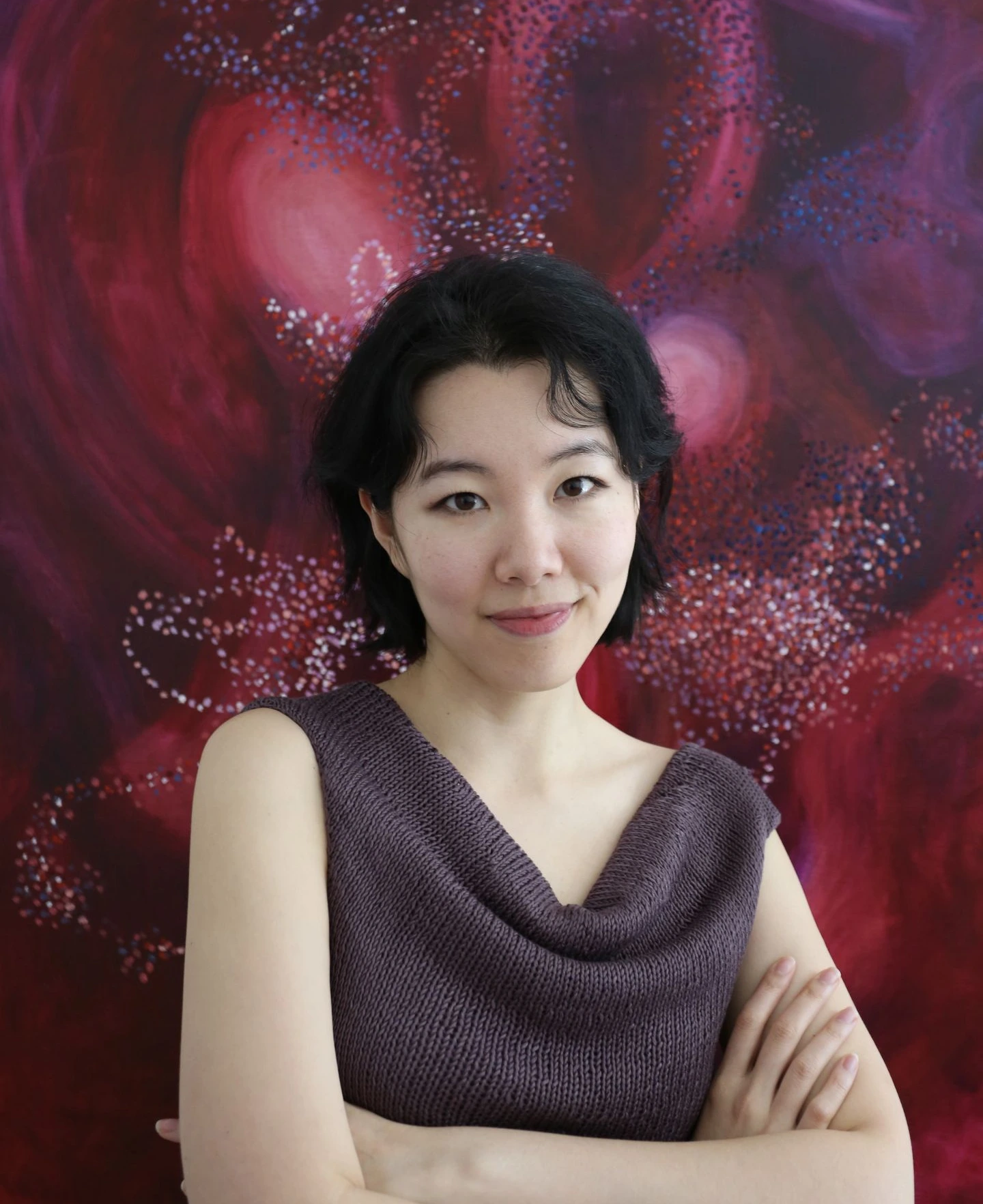
Anqi Zhou (周桉琪), PhD (b. 1995, Anhui, China) is a Paris-based artist exploring abstraction at the intersection of systems representation, perceptual structures, and evolution as a continuum. Trained in traditional Chinese ink painting and calligraphy, she later completed studies in applied mathematics and biology at Brown University, followed by a PhD in Neuroscience conducted at the Institut Pasteur and the Institut des Neurosciences Paris-Saclay, visualising continuous topology of real-world signals and hidden structures within the brain and consciousness.
Her practice develops from a sustained interest in abstract high-dimensional systems. Working primarily in oil painting, her work functions as iterative variations within defined parameters, where perturbation, dynamic behavior, and probabilistic operations shape the emergence of form and colors. She seeks to investigate how complex real-world systems can be translated into visual fields, where non-visible structures are brought alive through movement, density, and spatial tension.
FROM THE ARTIST'S DESK
The more I study neuroscience and the evolution of intelligence, the less I believe that our species is the most intelligent one on Earth. Brainless slime mold can both remember and solve complex path optimization problems. Ants build graveyards and bees shimmer in unison. More recently, we created algorithms capable to compute and iterate thousands times faster than our brains could ever evolve to do. I do believe, however, that despite how bad we are at most things, there are two realms where humans shine more than anything else: abstract reasoning--the discovery of invisible physical laws that govern every aspect of our existence, and our ability to create art for the pure sake of pleasure, intellectual fulfillment, self-expression, and communication with another. Without the curious inquiry into the mechanisms of our environment or the romantisization of our small lives spent in such environment, humanity would be lost in every possible universe.
The idea of painting music, as obscure as it sounds, is the cumulation of years of my lived experience, of romantisizing the worlds close to my heart. When I first moved to the United States when I was thirteen, it was joining my local chorus that comforted me and assuaged my covert fear, anxiety, and deep loneliness from nosediving into a completely different life and culture. It was easier to communicate and connect with people who held a mutual penchant for Mozart, Brahms, Gounod, Brukner, and Faure. I kept on singing in choruses for a decade, and somewhere along the way picked up the violin and played in an orchestra (badly), all because music is the one human language that doesn’t need translation to emote. And I think that’s worth more than just listening to.
Painting music is a translation problem. Like any physicist, my underlying goal is to transform the messily sampled temporal signals into ones that are recurrent and simple by shifting into a different coordinate system that is still time-explicit. I was inspired by the research I did at the Pitié-Salpêtrière Hospital, where I analyzed motion kinematics of Parkinson’s patients as a continuous system without dictating what their movements were a priori. We let their movement define its own dictionary and grammar. In a similar way, I’m expanding the music we hear, which fundamentally is a wave, from one dimension (time) into a higher dimensional state space, then collapsing that space into just four dimensions that capture the most amount of the underlying dynamics. Physics provides the rules, mathematics provides the language, and painting provides the expression.
I do not claim that I've somehow captured all physical properties of all types of music, for although my methods work for the smooth and sultry romantics, it is currently terrible at capturing the complex counterpoints of Bach, the polyrhythmic swing of jazz, or any contemporary pieces where language adds another layer of depth and profoundness. But the most fun thing about being a scientist is the endless, continuous pilgrimage to learn, investigate, and experiment. And in the process of doing so, I hope to share how my mind dreams about music, in meek search of souls that resonate in the same phase.
Paris, 12 Feb 2026